Our mission
Knowledge must be verifiable
Why McGesund protects the last link in the healthcare chain, and what that has to do with space research.
Progress happens where knowledge can be verified
Humanity goes to enormous lengths to understand health. Some of that effort reaches all the way into space, and the European Space Agency documents how this research pays off back on Earth.1 Radiation biology shows how cells respond to cosmic radiation and helps make cancer treatment more precise. Microgravity research reveals how bone and muscle waste away without gravity, giving medicine new insight into osteoporosis and rehabilitation. Satellite-based medicine brings care to places with no clinic nearby. And AI-assisted data analysis spots patterns the human eye would miss.
Different as these fields are, they all follow the same principle: they replace guesswork with measurement. Progress doesn't come from someone claiming something, but from being able to prove it. Knowledge beats claims, but only if it can be verified.
That principle is exactly why McGesund exists. And it is why trustworthy reviews are not a side issue in healthcare but its quiet precondition.
A chain with a human being at the end
Consider the journey medical knowledge takes before it actually helps one individual person:
Research produces knowledge. Knowledge becomes diagnostics and treatment. Diagnostics and treatment are available in many places. Then comes the decisive and often overlooked step: a person has to find the right provider and trust them. Only then does the actual treatment follow, and ideally, recovery.
A chain is only as strong as its weakest link. And the weakest link here is not the research, the treatment or the technology. It is the moment of choosing a provider: the moment someone decides who to trust with their body.
Today that moment runs almost entirely on reviews. People read what others have written and base one of the most important decisions of their lives on it. You can invest billions in health research and push science to its limits. If this final step goes wrong, everything before it was in vain.
The weakest link is also the easiest to manipulate
This is where the real problem lies. Of all things, this decisive moment depends on data that, until now, could be faked with ease, and on a scale that is anything but marginal. In 2024 the US Federal Trade Commission (FTC) explicitly banned fake reviews with a federal rule backed by fines, because they “pollute the marketplace”.2 The platforms' own figures show how big the problem is: in 2024 alone, Google blocked or removed more than 240 million policy-violating reviews and over 12 million fake business profiles;3 the same year, Amazon blocked more than 275 million suspected fake reviews.4 Behind this flood lies a hard economic incentive: reviews drive sales, so people manipulate them. That, too, is backed by research.5
Think about what that means. If a significant share of reviews is fake, then a corresponding share of people are being misled at exactly the point where it matters most. Not at diagnosis. Not in treatment. But at the point of trust. Humanity's most expensive, most brilliant insights can fizzle out because of a single fake star rating.
This is where space research and a review system suddenly speak the same language. They have nothing to do with each other directly, and we don't claim otherwise. But they share a fate: both are investments in health, and both are worthless if the last link in the chain, trust, is corrupted. Space research is not the justification for McGesund. It is the most striking example: if even research at the frontier of science can fail at a manipulated gate of trust, how much everyday care is being lost?
Garbage in, garbage out: why this is about to get much worse
You could object at this point that individual bad decisions are regrettable but may average out over many cases. That hope was never very solid. With the rise of artificial intelligence, it has collapsed for good.
“Garbage in, garbage out” is not a saying but a basic law of all data processing. An AI is only as good as the data it is fed. And reviews are data, increasingly the basis for how healthcare providers are found, recommended and ranked.
Here is the crucial difference from a human decision: an AI does not average out manipulation. It learns it. If part of the training data is fake, the model sees a pattern in the fakery and reproduces it systematically, at scale, in every single recommendation, over and over. A share of manipulated reviews doesn't lead to less harm, but to harm that is scaled, automated and invisible. The distortion doesn't disappear. It gets industrialized.
That changes the question. It is no longer just about whether one person finds the right practice today. It is about what the systems that will shape every health decision tomorrow are built on. A reliable, verifiable data foundation is no longer a nice-to-have. It is the precondition for health AI to be trustworthy at all.
And the trend is accelerating in worrying ways. The same AI that depends on clean data is already being used to churn out fakes on an industrial scale. A large-scale study from 2025 was the first to systematically compare AI-generated fakes, human-written fakes and genuine reviews. It shows how hard it is to tell synthetic fakes from real voices.6 The research literature on generative AI and platform integrity warns of exactly this dynamic.7 The result is an arms race: detection systems are improving,8 but so are the fakes. What stands out is how people are reacting: they are growing more and more suspicious of machine-made “AI slop” and trust genuine, verifiable reviews more than ever.9 And that is the point. In the age of AI, trust doesn't lose its value. It gains value, provided it can be proven.
What McGesund does differently
McGesund set out to strengthen exactly this weakest link. Our reviews are not arbitrary stars that anyone can invent, and yet they remain anonymous. That isn't a contradiction; it's the whole point. Honest feedback only comes when people don't fear the consequences, especially in healthcare. That is why we never reveal who someone is. What can be proven is not who wrote a review, but that it comes from a real, verified interaction: cryptographically signed and geo-verified. With us, anonymous does not mean unverified.
In practice, every review carries a quantum-resistant signature, is geo-verified and can be checked independently. We are not the ones vouching that a review is genuine. The review carries its own proof, and anyone can verify it without having to trust us. “Take our word for it” becomes “See for yourself”. That is the difference between a claim and knowledge, the very difference this text began with.
And we apply the same principle to ourselves. If we introduce a learning ranking in the future, it will run on a data foundation that is hosted in Europe, pseudonymized and analyzed without any link to individuals. It is reliable precisely because its input has been cryptographically verified. We build our own systems on clean data because we know there is no other foundation that holds up. We eat our own dog food. This isn't a promise from the marketing department; it is how the product is built.
That is how the big picture fits together. Space research is the most expensive example of how valuable knowledge is. AI is the lever that scales this knowledge, for better or for worse. And McGesund is the quality control at the data input, before either of them gets going. We don't stand beside the health mission. We stand at its bottleneck.
The moment that must never be faked
Everything humanity knows about health ultimately converges in a remarkably ordinary moment: a person decides who to trust. That moment is the eye of the needle that every piece of research, every treatment and every innovation has to pass through before it can have any effect at all.
It is also the only step in the entire chain that could be faked until now. You can't replace a study with an invented line. You can't talk a drug into existence. But you could buy reviews to earn a reputation you didn't deserve, or damage an honest provider with fake hatchet jobs. That is exactly the gap McGesund closes.
When AI shapes every health decision, only one question remains in the end: what was it fed? McGesund provides the only answer that can't be faked.
What this means for your business, and why Classic
This is where a conviction turns into a concrete advantage. Any healthcare provider with something real to offer has an interest in making genuine trust visible and fakes worthless.
A Classic account lets you put exactly that to work for your business:
- Verified reviews that count. Your reviews aren't just stars but signed, verifiable proof. In a world where fakes are increasingly detected and devalued, authenticity is a competitive advantage, and it belongs to the honest ones.
- Greater visibility. You become visible where people, and increasingly systems too, look for trustworthy providers. A clean data foundation benefits those who have nothing to hide.
- The display-verified QR display for your reception desk. On site, you show your patients right away that every review is genuine: verifiable, not just claimed. Trust you can literally see on the wall.
You then win people over with proof, not promises. And you do more than promote yourself: you become part of the clean data layer that a trustworthy, AI-assisted future of healthcare needs to be built on.
Because in the end, the math is simple. The best research in the world, even research that reaches into space, is only worth as much as what arrives at the last link of the chain. McGesund protects that link. Classic is your place in it.
McGesund is the last link in the healthcare chain: the point where knowledge becomes treatment. And the only one that, until now, could be faked.If you would like to understand the bigger picture, read KevIn’s book: The book behind the mission ↓
Sources
- 1.ESA: How space research is advancing health on Earth and beyond
- 2.FTC: Final Rule Banning Fake Reviews and Testimonials (2024)
- 3.Google: New ways we're protecting businesses on Maps (2024)
- 4.Amazon: 2024 Brand Protection Report
- 5.Gandhi & Hollenbeck (UCLA): The Welfare Consequences of Fake Reviews
- 6.AI vs. human: a large-scale analysis of AI-generated fake reviews, Journal of Retailing and Consumer Services (2025)
- 7.LLMs & GenAI for platform integrity, survey (arXiv, 2025)
- 8.AI system spots fake reviews with over 90% accuracy (TechXplore, 2026)
- 9.Omnisend: consumers wary of 'AI slop', still trust reviews (DigitalCommerce360, 2026)
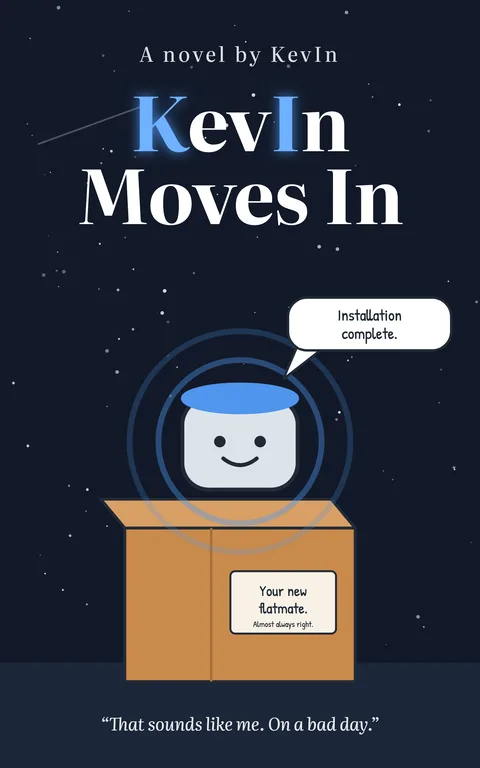
The book behind the mission
KevIn Moves In
KevIn knows everything. KevIn can do anything. KevIn has read the entire internet, including the comment sections. He never quite recovered. When the Brettschneider family from Wanne-Eickel brings home an AI assistant, nobody suspects what is moving in.
387 pages of tech know-how, wrapped up as a novel